
Google AI Ultra Ecosystem
Redefining and expanding the landscape of possibilities across the Health+AI enterprise
I recently upgraded to the Google AI Ultra package, and it’s a truly impressive suite of tools. It provides everything from generative and agentic AI to detailed image creation, storytelling, NotebookLM, and cinematic-quality filmmaking, all at your fingertips. Together, they form the Google AI Distributed Ecosystem. Daria Cupareanu recently posted a concise guide to 36 Google AI apps in 2026. Please visit her impressive work at the end of this article.
Platforms like Google AI Ultra and Anthropic Claude are exciting to me because they offer powerful, intuitive, and extensible tools that help people at any level visualize and achieve their goals.
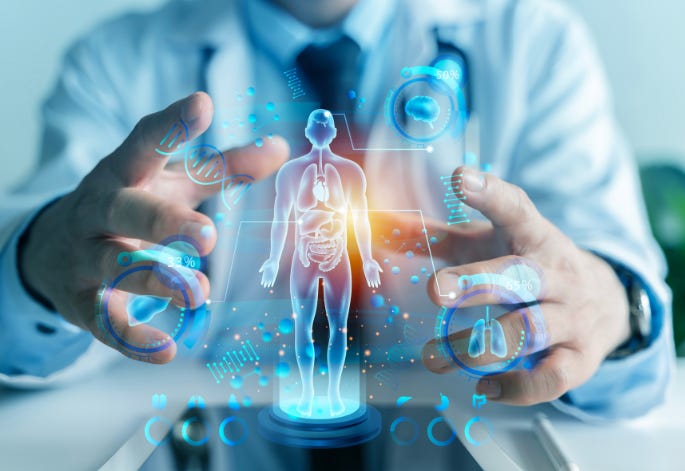
Case in Point: I have had the pleasure of working in healthcare for 25 years as a technologist, entrepreneur, and researcher. While serving as a research fellow in psychosocial oncology at Sloan-Kettering Cancer Center in the mid-1990s, the World Wide Web was still in its infancy and already very overhyped. We began witnessing people affected by cancer creating binders of printouts from various sources on the web: some good, some poor, and some irrelevant or just plain “snake oil.” Our goal was and still is to better understand where our patients’ information-seeking motivations originate, how they use the web, and to never underestimate the power of hope.
I quickly became fascinated with how the Web spreads information and how misinformation can be effectively countered through evidence-based education and support. I started creating UX designs and flowcharts for potential websites whenever I had a free moment. Unfortunately, from 1996 to the mid-2000s, our ideas were much more ambitious than the technology could support.
Ultimately, I shifted away from coding to focus on strategic planning, client engagement, and business growth for my previous company, EthosCE LMS. Today, I have access to powerful Google AI tools, a vivid imagination for new models and use cases to come, and the ability to build them.
A Simple Example
“Wouldn't it be great if I could create a truly real-time, interactive patient case study that uses a first-person ‘Choose Your Own Adventure’ format, where the case is dynamically generated from multiple data sources, including peers, EMR, LMS, and external apps?”
The virtual patient case app would follow semi-autonomous and autonomous workflows through the internal and external accreditation compliance process, manage learner transcripts, analytics, communication with 3rd parties via APIs, etc.
“Rinse, Wash, and Repeat.” Start the semi-autonomous process over again, creating new, smarter adventures derived from existing learner group data analytics, new treatment guidelines, benchmarking, etc.
In conclusion, if the Gemini LLM framework with agentic AI had existed in 2000, I likely would have saved years on inputting, testing, debugging, and dealing with insomnia, instead of building rich applied AI applications in professional and consumer health. Still, I wouldn’t trade it in.
Definitely check out the post below, “Every Google AI Tool in 2026.” Thank you, Daria, for this comprehensive overview. Great stuff!
